

Crossing the Segment Line: What AI Changed, and What It Didn't
AI is changing the old economics of crossing customer segments in software M&A. Cost to serve, pricing, and feature fit are becoming easier to underwrite, but go-to-market still depends on trust, buyer access, and domain credibility. This piece looks at recent deals from Salesforce, Atlassian, Canva, and Thomson Reuters to show what AI changed, what it did not, and how diligence and M&A playbooks need to evolve.
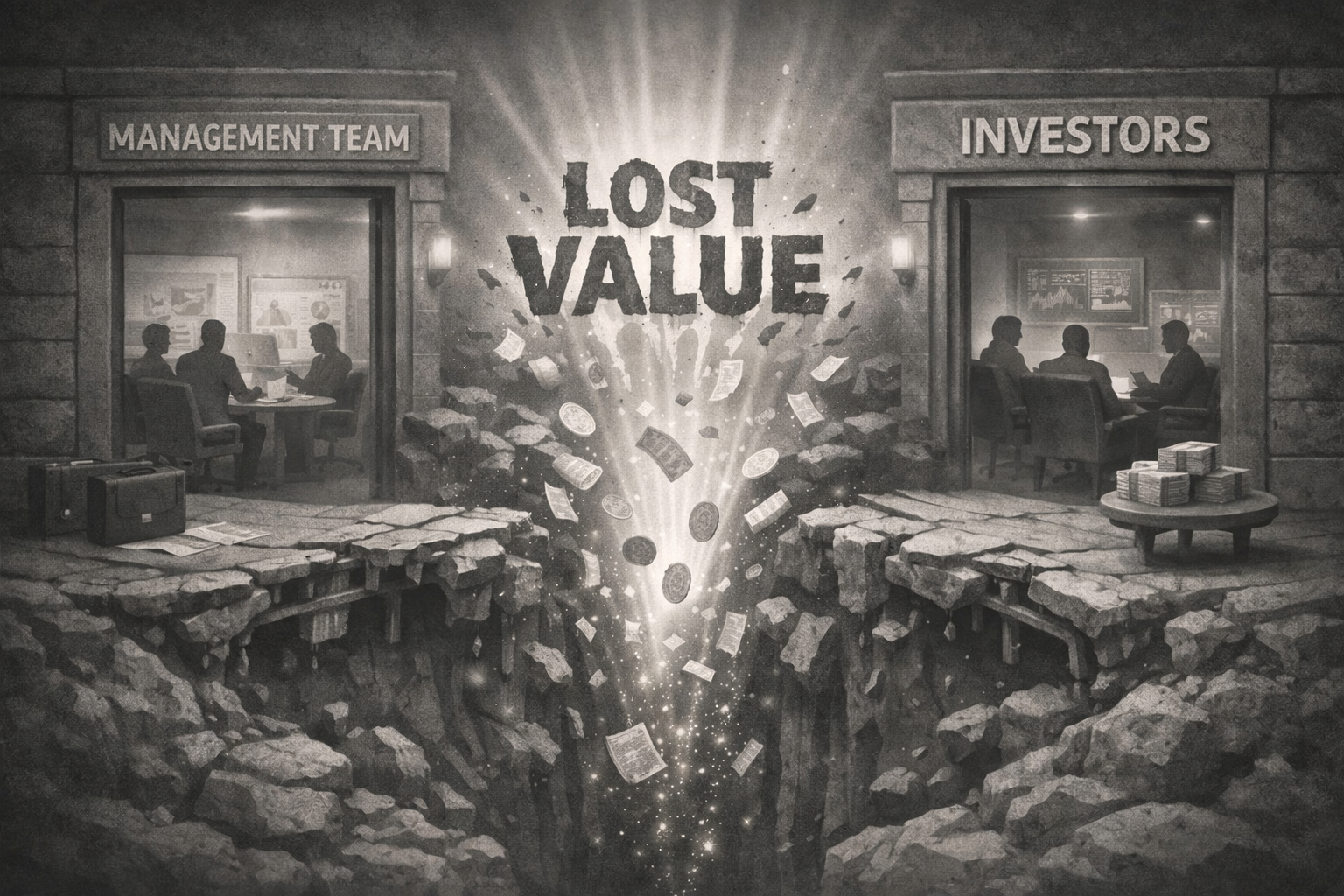
Capital Follows Credible Repositioning
Most capital formation breaks down when companies start telling tomorrow’s story with yesterday’s operating model. This piece is about what has to change across product, sales, recruiting, reporting, M&A, and external communication to make repositioning believable.

Keeping Founders Engaged After a Bolt-On Acquisition
Bolt-ons fail when founder retention gets treated like culture, instead of operating design. After close, decision rights blur, speed slows, and founders get measured on outcomes they cannot control, which turns motivation into resentment.
This piece lays out why founders disengage, what different founder archetypes need to stay effective, and how to design the post-close system so the deal rationalize is realized.

The Founder Guide to Being “Acquisition-Ready”
Most acquisitions don’t happen because a buyer loves your product. They happen because a buyer can underwrite the business fast, without guessing. This post is meant for founders and CEOs. It lays out the “acquisition-ready” packet that reduces surprises, prevents re-trades, and gives you leverage even if you’re not trying to sell.

Why Most AI Roadmaps Are Backwards
In a previous post, How to Monetize Your AI Roadmap, I introduced a simple framework for understanding why most AI initiatives stall before they ever generate real revenue.
This piece picks up where that framework leaves off.
It argues that the root cause of the AI revenue gap is sequencing. Most teams design AI roadmaps starting with features and work backward to monetization. The teams that succeed reverse the order. They start with the outcome they want to own, define the pricing unit that captures its value, and only then design the roadmap.
This post explains why feature-first roadmaps fail, what pricing-first roadmaps look like in practice, and why this distinction increasingly determines product success, valuation, and M&A outcomes in the AI era.

Competitor Acquisitions: The Migration Playbook
SaaS consolidation is accelerating, not because it’s fashionable, but because it’s practical. With many assets trading at 3x to 5x revenue and organic growth harder to manufacture, investors are leaning on consolidation to create scale, take out cost, and build credible AI capabilities on top of larger install bases.
But competitor acquisitions don’t succeed in the model. They succeed in migration. Retention, timing, and cost discipline matter more than headline synergies, especially when AI raises the penalty for split platforms, fragmented data, and delayed unification.
This piece lays out a practical playbook for migrating customers without destroying value, why some churn is not only inevitable but rational, and how front-loading migration thinking in diligence leads to better deals, better execution, and more believable valuations.
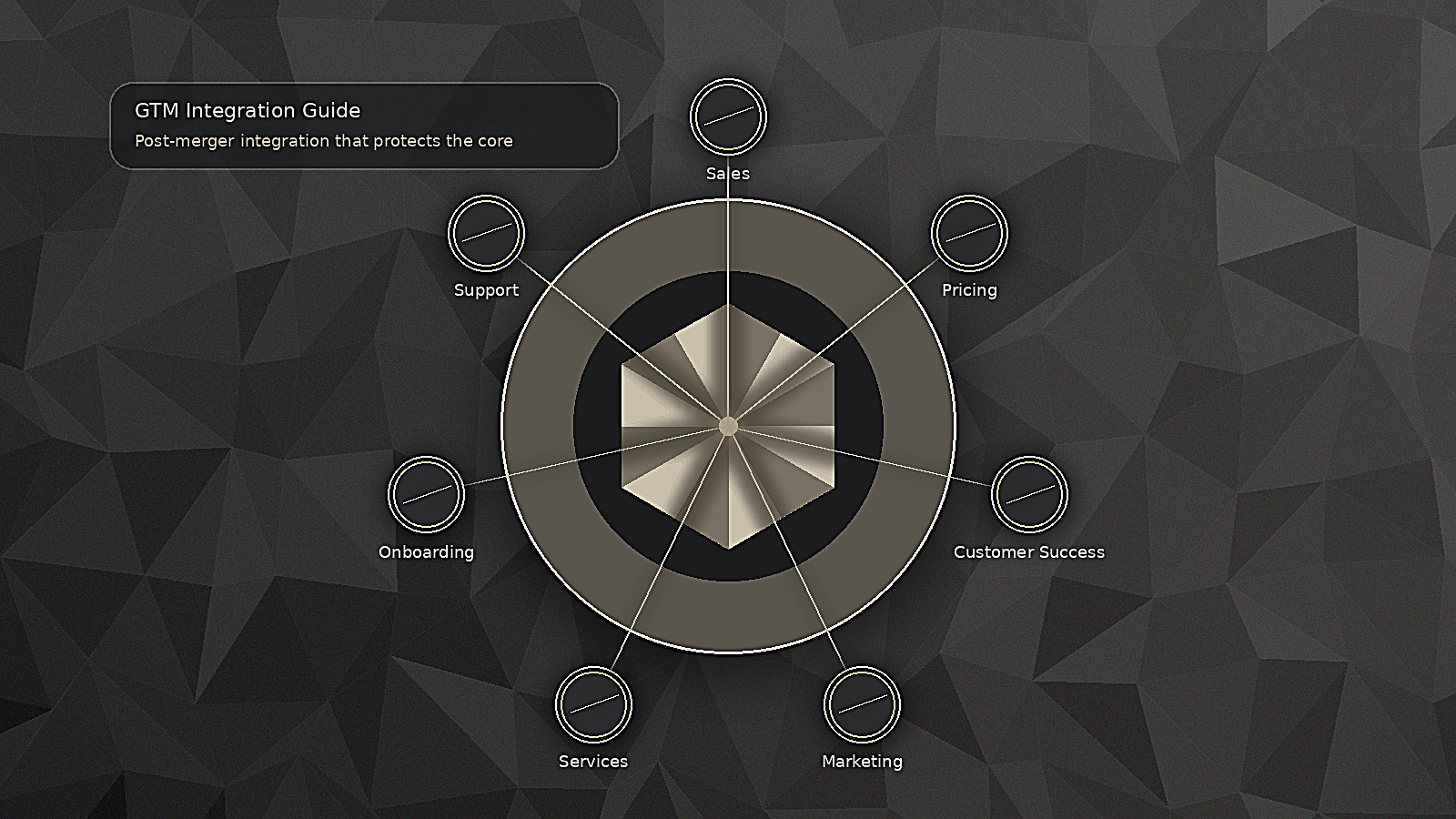
The GTM Integration Guide
Most GTM integration plans are busywork: website updates, enablement decks, system merges. The board doesn’t care. This guide breaks down the few decisions that matter first, how to coordinate Sales, Pricing, CS, Marketing, Services, Onboarding, and Support, and the simple metrics that tell you when to push, pause, or stop, without slowing the core business.
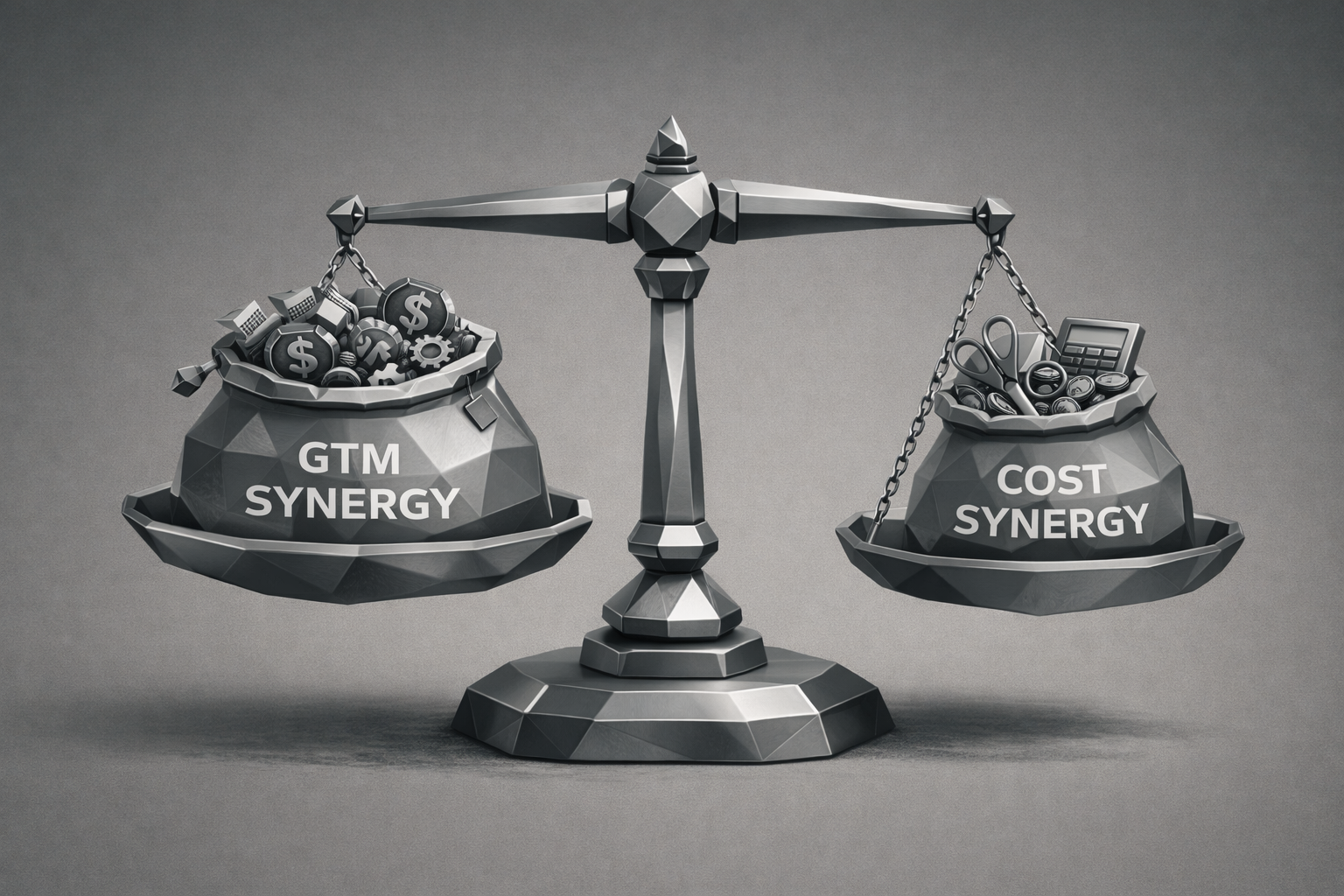
Why the Real Synergy in SaaS M&A Is GTM, Not Cost
Most M&A models still lead with cost takeout because it’s easy to count and easy to defend. But in SaaS, the value that actually compounds is usually commercial: attach, bundles that earn pricing power, workflow depth that lifts NRR, and distribution that accelerates cycles. This piece lays out a simple taxonomy of GTM synergies, why “modeled” revenue upside so often fails to show up, and the underwriting checklist that forces reality: eligible base, proof motion, capacity, integration depth, and the metrics that tell you early whether the flywheel is real.

The SaaS + AI GTM Playbook
In my earlier post, How to Monetize Your AI Roadmap, I laid out the ladder: Capability → Feature → Product → Digital Labor. This post is the GTM companion. As you climb that ladder, the go-to-market has to change.
If you treat AI as “just another feature launch,” you will ship plenty of capability and stall on revenue. This playbook is how to avoid that.

You Don't Get Re-Rated “Just for AI”
This follow-up grounds my earlier “re-rating” thesis in underwriting reality, laying out three lanes for PE-owned SaaS assets (compound, consolidate, transform) and the tests that separate real AI value creation from packaging.

How to Monetize Your AI Roadmap: A Framework
AI adoption is accelerating, at a faster rate than AI revenue. This article introduces a four-level framework for AI monetization, spanning Capability, Feature, Product, and Digital Labor. Using real-world examples from Zoom, GitHub, Intercom, and Klarna, it explains why most AI initiatives stall at the lower levels, how pricing power correlates with workflow integration and economic ownership, and what it takes to move from bundled functionality to outcome-based revenue. The result is a practical guide for product leaders, operators, and boards trying to turn AI investment into durable business impact.

PMI in the AI Era: How to Make AI Acquisitions Actually Work
AI tuck-ins only create value when the acquired capability plugs into the core data model, workflows, and decisioning engine of the parent platform. Most fail not because the technology is weak, but because the PMI playbook was built for the cloud era, not the AI era. This post breaks down how AI PMI differs fundamentally from cloud PMI a decade ago. Done right, AI PMI turns small acquisitions into platform-level transformations, and translate to material enterprise value.

Unified Platforms: The Real Moat is Built Before You Build AI
Flashy AI demos are easy. Compounding intelligence is not. The companies that win build unified platforms first, then use AI to accelerate learning. Everyone else is just adding features to systems that can’t compound.

Why AI Value Creation and Value Capture Are Diverging
Are you building "Surface Area" AI or "System" AI? I analyze the 2025 State of AI reports from both Battery Ventures and McKinsey to show why most integration strategies fail and how the right M&A playbook can move you from “Pilot Purgatory” to durable enterprise value.
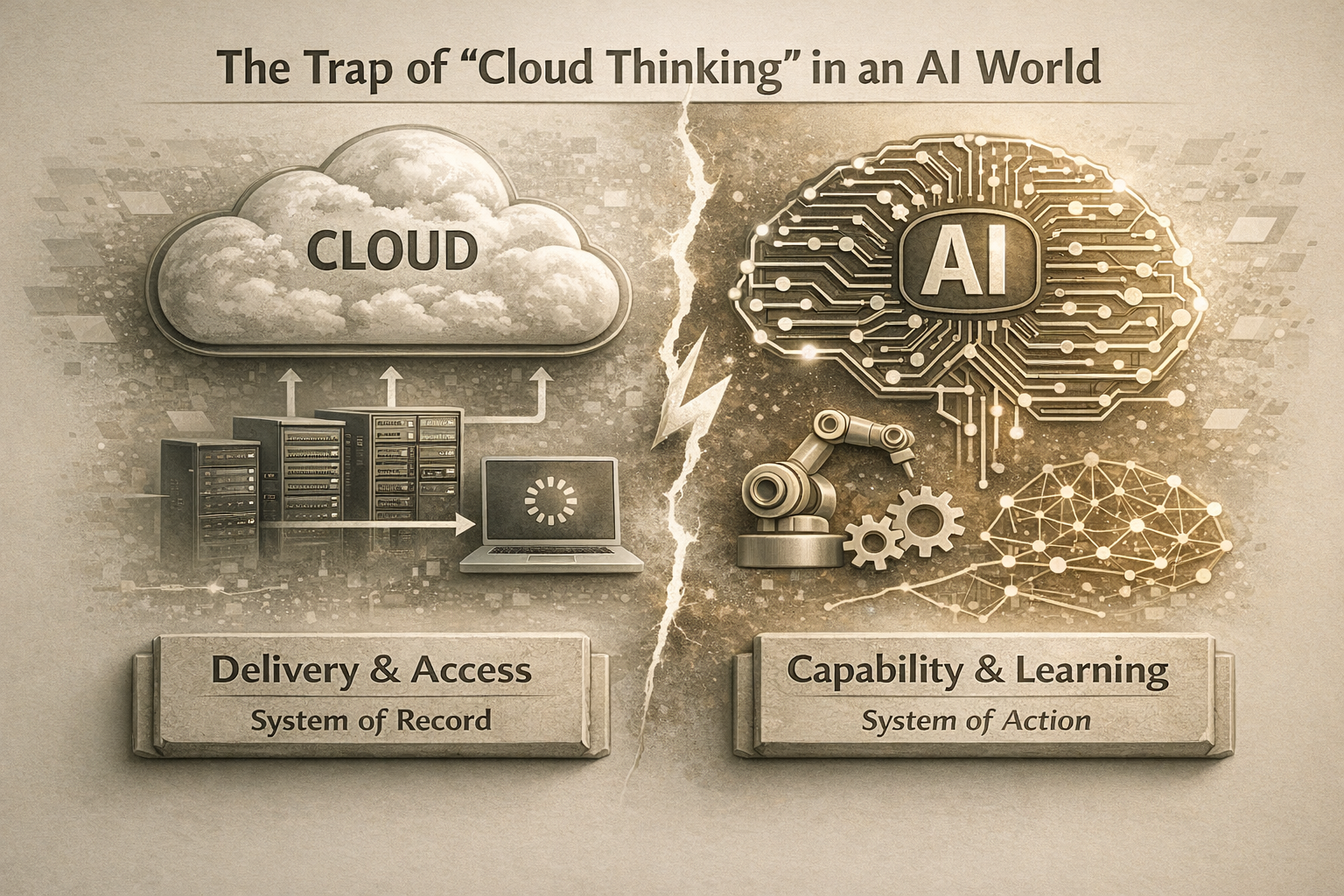
The Trap of “Cloud Thinking” in an AI World
Most leaders approach AI with cloud-era instincts. That mistake is costly. Cloud was a delivery upgrade. AI is a capability shift. It rewrites how software creates value, compounds advantage, and pulls winners away from laggards.

AI-Ready M&A: How Acquirers Should Evaluate AI Compatibility
Most AI vendors can produce a great demo. The real question is whether their underlying product, data, and engineering foundations can support AI at scale inside a larger platform. Learn how to spot the difference between "demo-ready" and "AI-ready" before you sign the LOI.

AI: Bubble, Breakout, or Both?
AI isn’t one big wave. It’s a mix of technologies maturing at different speeds, which is why the market feels both overheated and full of genuine breakthroughs.
For companies that weren’t born AI-native, the strategic question isn’t “Is AI a bubble?” It’s “Which part of AI actually moves the needle for our business?” Getting your strategy, architecture, and sourcing engine in place now is what determines whether you’re playing offense when the opportunity is right for your business.

How to Build a Repeatable M&A Engine That Increases Enterprise Value for SaaS
Most SaaS companies talk about M&A as a one-off decision. The ones that consistently create enterprise value treat it as a repeatable operating model. This article breaks down how leading platforms build disciplined, programmatic M&A engines that compound value over time. It lays out a practical operating model spanning strategy, sourcing, evaluation, SteerCo governance, integration, and early success metrics. The piece also clarifies the roles of the CEO, CPO, CFO, CRO, and Corp Dev leader, and highlights where most companies succeed or fail.

How to Re-Rate Your Pre-AI SaaS Assets into AI Valuations
SaaS multiples have reset, but AI multiples haven’t. Many SaaS platforms bought during the 2017–2021 cycle still have strong cores. They’re just stuck in a market that is now rewarding the next technological shift of AI, and the economics it represents. This piece lays out a practical, investor-focused playbook for identifying which assets can evolve, how targeted AI-led acquisitions accelerate that shift, and why decisive product and architectural transformation is the only path to re-rating into the AI valuation cohort.

Build vs Buy: The Hybrid AI Strategy Reshaping CX
As AI reshapes customer expectations and compresses product cycles, most CX vendors are being pushed into a critical decision: build AI internally or buy it. The truth is that neither path works on its own. This post breaks down why a hybrid model is emerging as the most realistic way forward.